Introduction
Creating a digital future for the insurance industry has been a strategic imperative now for over two decades. However, despite all the progress that has been made, and all the digital solutions that have been deployed, this future has still not really happened. In short, the fundamental requirements for the digitalisation of contracts have not been properly addressed, and until they are, a true digital transformation of the insurance industry will lie beyond our reach (Cummins, 2020[17]).
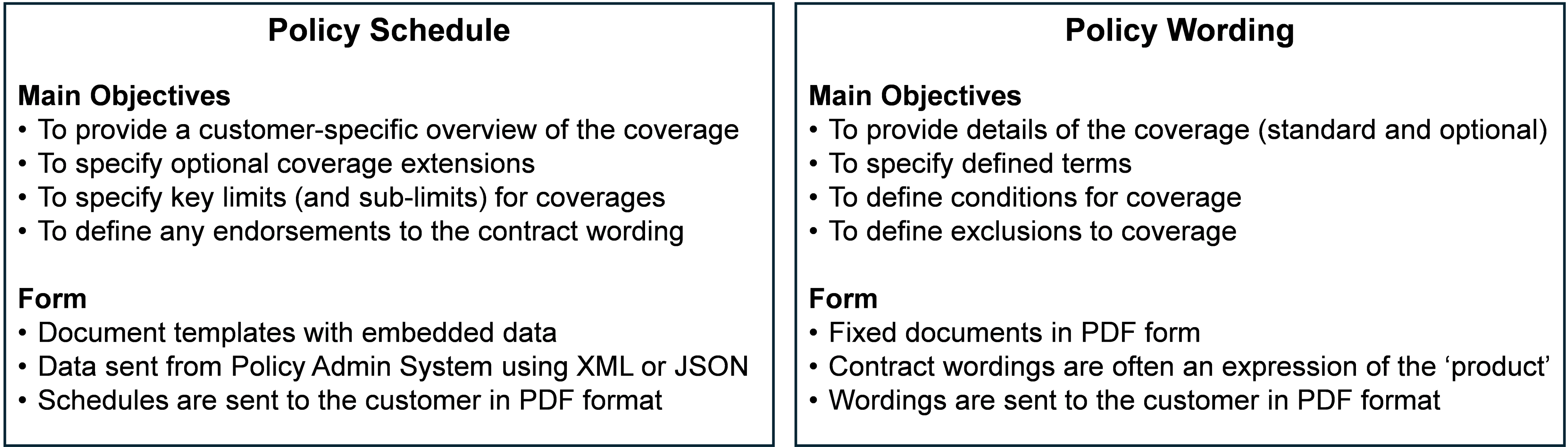
An insurance policy is essentially a contract that promises to indemnify the holder in the event of loss. Most of the contractual details are contained in the policy wording, usually a monolithic document that can often be over one hundred pages in length, and in the schedule, which itself may be considered as a proxy for a summary of the contract. A general description of each of these fundamental objects is shown in Figure 1, “The two principal insurance contract objects: the policy schedule and the policy wording.”.
Figure 1. The two principal insurance contract objects: the policy schedule and the policy wording.
 |
All the details contained in the policy schedule are stored as structured data in a policy administration system (PAS), while the policy wording itself is stored as a pdf, either on the PAS or elsewhere. It is important to recognise therefore that the policy wording is essentially an inert object that contributes nothing (other than performing the function as an accompanying reference document) to the structured and dynamic dataset pertaining to the schedule.
In their current form, the policy wordings of today suffer from three major shortcomings:
First, they are managed as stand-alone objects with little (if any) application of component reusability. Consequently, the same intended coverages may differ across the full set of products, simply because they have evolved separately. This makes the process of updating policy wordings an expensive and time-consuming process.
Second, they are static documents, and it is often the case that only parts of the policy wording will apply to individual customers, while the remainder is irrelevant (or even in contradiction with the schedule). The schedule performs the dynamic function of customising (and overriding) the policy wording through ‘endorsements’. Crucially, it may not be entirely clear to customers as to whether they have coverage against certain losses, simply because the process of reconciling the policy schedule with any endorsements and the policy wording can be extremely challenging.
Third, the scope for supporting data analytics or automation for a variety of purposes is limited. In their natural language (unstructured data) form without semantic richness or associated metadata, the policy wordings can only be analysed using natural language processing, and more recently, generative AI. Adopting structured data approaches to policy wordings will increase the level of computability and will enhance the performance of data analytics and levels of automation for both individual contracts and bodies of contracts.
[17] Cummins, John. 2020. “Automating (Re)insurance through Computable Contracting.” Version 1.1. https://axiomepartners.com/wp-content/uploads/2020/08/Automating-Reinsurance-through-Computable-Contracting.pdf.